Gastbeitrag: Insights into the development of a second major biodiversity model: BES-SIM 2
BES-SIM 2 - a global, multidisciplinary model intercomparison exercise developing future projections of biodiversity and ecosystem service change - will contribute to the upcoming IPBES 2nd Global Assessment. By Prof. Henrique Pereira.

Prof. Henrique Pereira, Martin Luther University Halle-Wittenberg, German Centre for Integrative Biodiversity Research (iDiv) Halle-Jena-Leipzig, Coordinating Lead Author, IPBES Monitoring Assessment
The IPBES 2030 work programme includes “supporting policy” as one of its six objectives. This includes advanced work on scenarios and models of biodiversity and ecosystem functions and services. A core task is catalysing the development of new scenarios and associated models for the future work of IPBES.
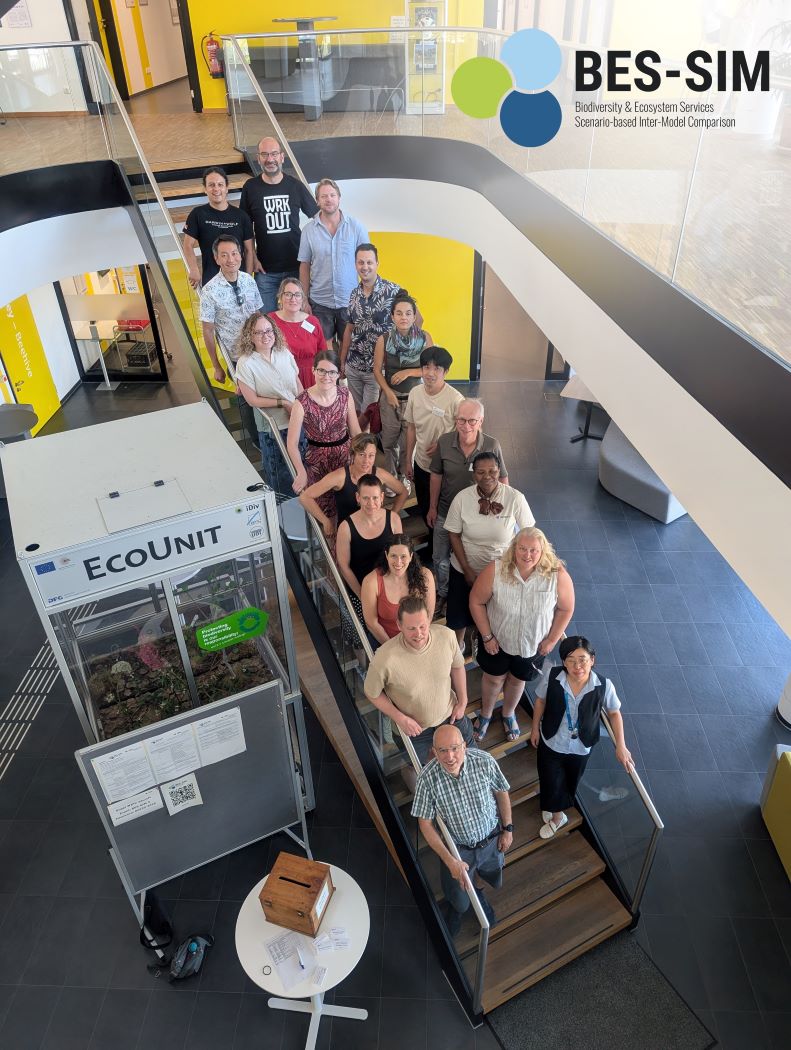
Gruppenfoto der BES-SIM Arbeitsgruppe am Deutschen Zentrum für integrative Biodiversitätsforschung Halle-Jena-Leipzig (iDiv).
iDiv
BES-SIM 2 is a global, multidisciplinary model intercomparison exercise developing future projections of biodiversity and ecosystem service change.
Building on BES-SIM 1 (Pereira et al., 2024, Science), this second iteration draws on the Nature Futures Framework (NFF), a set of plausible, positive futures for people and nature, to explore the combined effects of human and climate pressures across terrestrial, freshwater and marine ecosystems. It brings together 15 terrestrial and 10 marine modelling teams working at regional and global scales.
The exercise addresses the following research frontiers: (i) advancing model intercomparison as a means to assess future trends in biodiversity and ecosystem services and to test and quantify uncertainties across models; (ii) incorporating multi-scale modelling to link global trends with regional and local dynamics; (iii) integrating social-ecological feedbacks to capture the dynamic interactions between biodiversity, ecosystem services and human systems; and (iv) integrating terrestrial and marine domains within a comparable modelling framework. Outputs are delivered as Essential Biodiversity Variables (EBVs) in standardized, FAIR-compliant EBV data cubes, enabling transparent cross-model synthesis and reuse.
Through these advances, BES-SIM 2 will contribute to the upcoming IPBES 2nd Global Assessment and to support international biodiversity strategies, most notably the Kunming-Montreal Global Biodiversity Framework (KM-GBF) and the UN Sustainable Development Goals (SDGs), with a scientific base for conservation and sustainability decision-making.
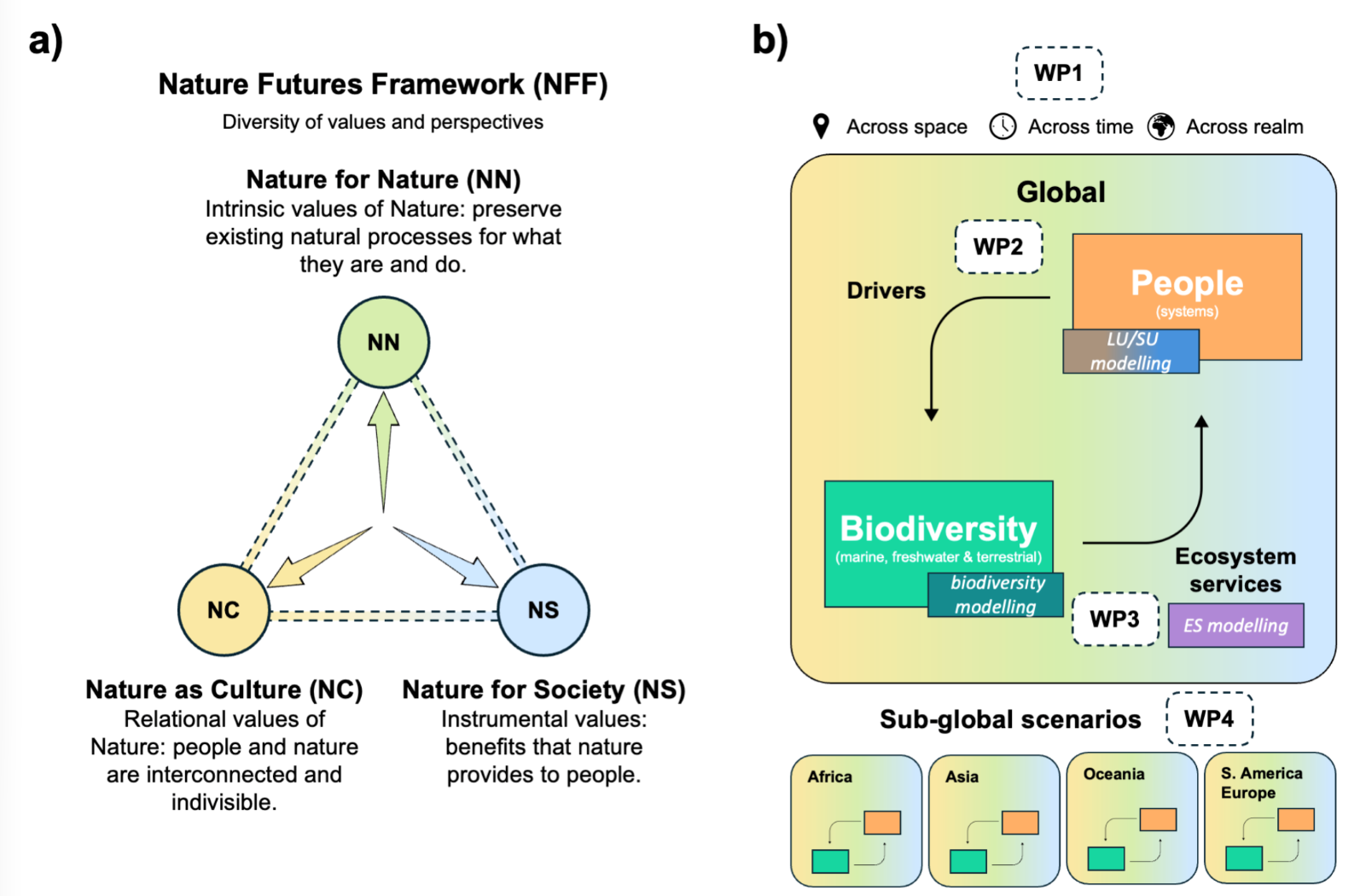
The modelling workflow and the research frontiers (RF) of BES-SIM 2. Policy scenarios (orange) are translated by LU/SU models (blue) into driver projections (white), which are fed to biodiversity and ecosystem service models (green) to project different metrics (white). State of the art in each RF are represented by red boxes while advancements are indicated in the green boxes. Dashes represent how the RF advancements improve the workflow. Text outside boxes represent models, datasets and tools used within the framework.
BES-SIM
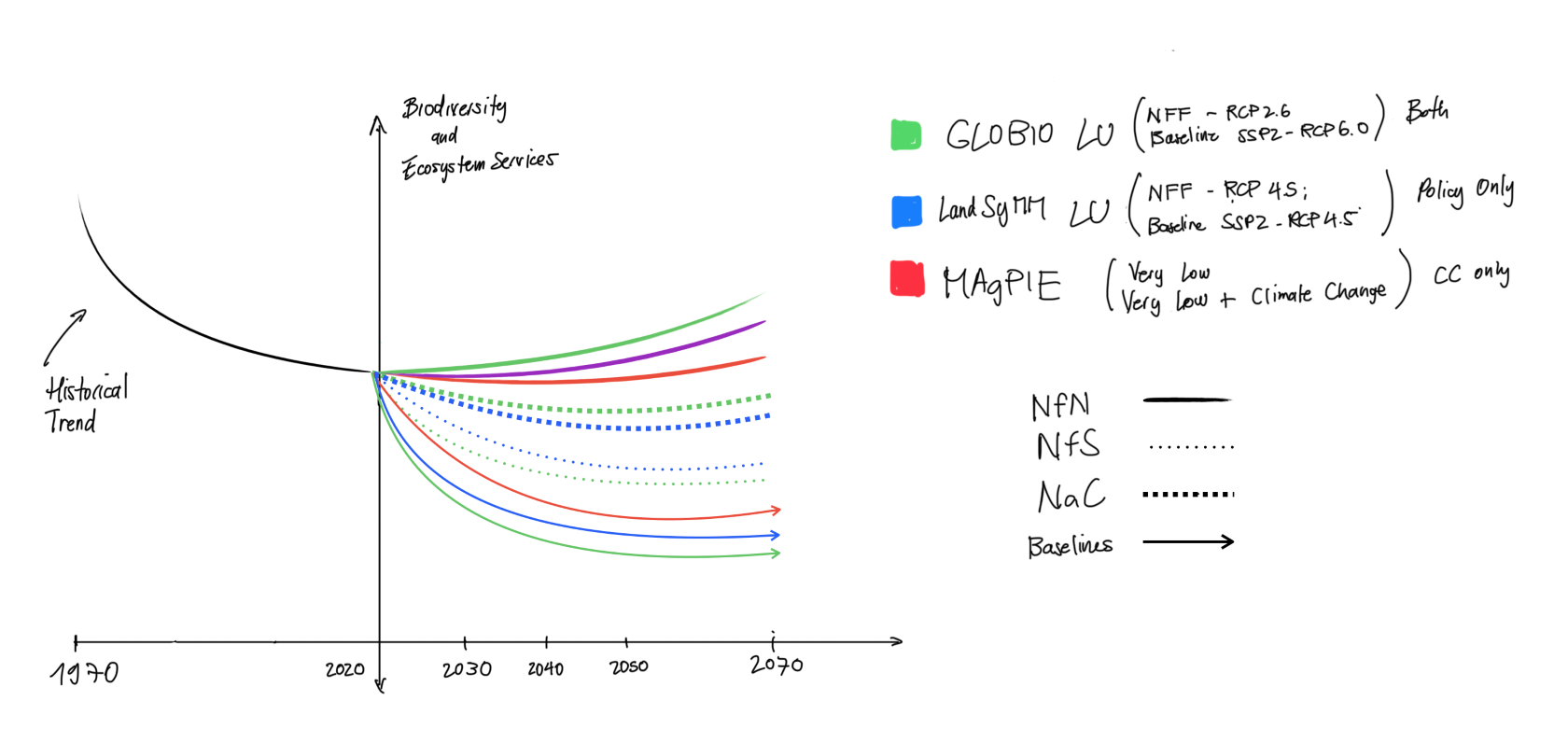
Schematic representation of relative biodiversity and ecosystem-service trajectories from 2020 to 2070 across alternative scenarios and model frameworks. Colors identify model frameworks (GLOBIO-LU, green; LandSyMM-LU, purple; MAGPIE, orange), while line styles distinguish scenario variants (solid, NfN; dashed, NfS; dotted, NaC; arrows, baseline). Curves are conceptual and indicate relative differences in direction and magnitude among scenarios, not quantitative projections.
BES-SIM